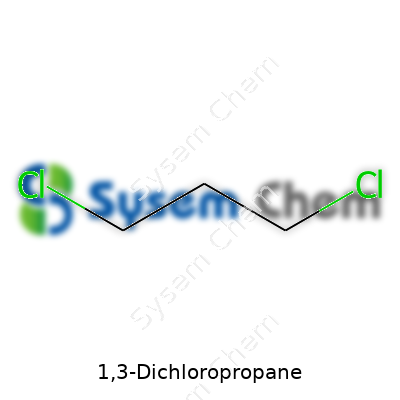
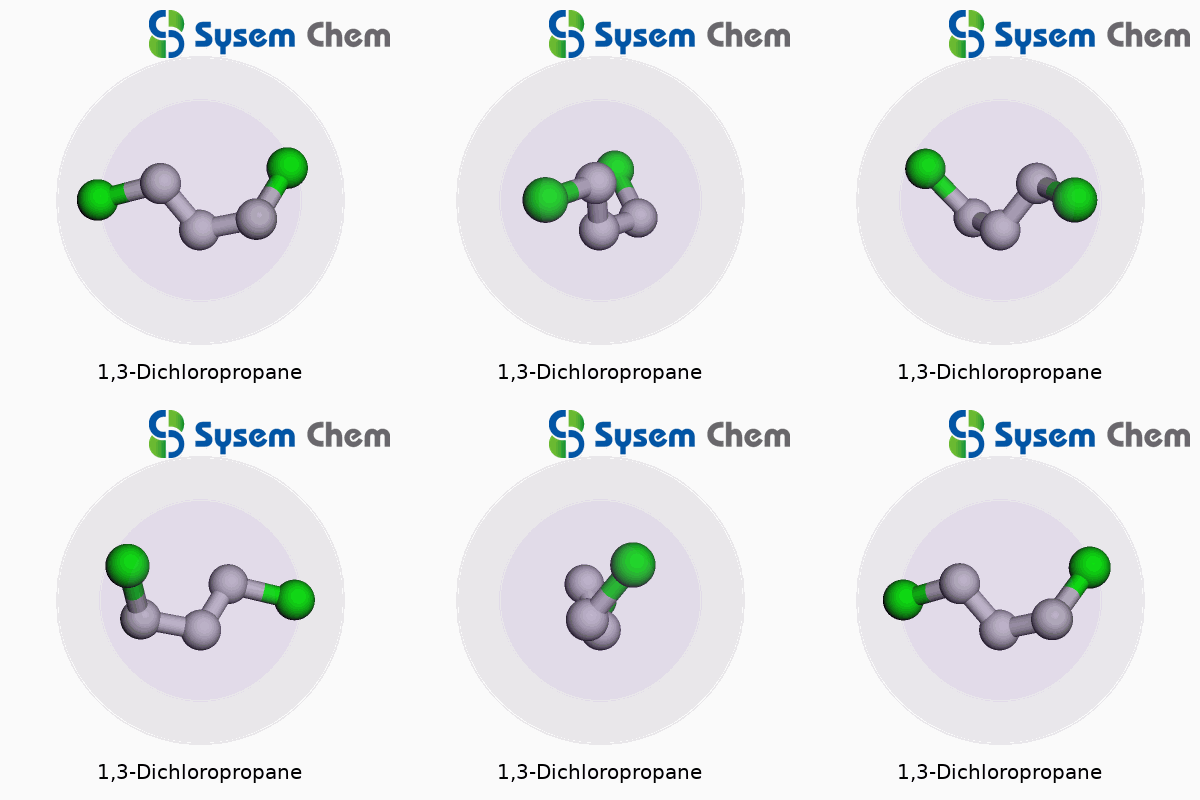
1,3-Dichloropropane: Deep Dive into a Lesser-Known Chlorinated Hydrocarbon
Historical Development
Chlorinated hydrocarbons have long played a supporting role in the toolbox of chemical industries around the world. 1,3-Dichloropropane gets its first mention in the literature back in the early 20th century, as researchers looked for counterparts and byproducts related to the heavier hitters like DDT or carbon tetrachloride. Agriculture and industrial chemistry, always on the lookout for novel molecules, found chlorinated propanes interesting due to their dual chlorine handles on a three-carbon backbone. Much of the historical drive came from efforts to clean up production streams of other chemicals, so discovery often happened not in isolation, but attached to large-scale synthetic chemistry progress, such as the manufacture of allyl chloride and epichlorohydrin. Over the decades, accidental discoveries morphed into process optimization, and before long, methods to produce purer 1,3-dichloropropane emerged, prompted by evolving industrial needs and environmental scrutiny.
Product Overview
1,3-Dichloropropane counts as a clear, colorless liquid, sporting a faintly sweet but pungent odor. Most people working in chem labs rarely encounter it outside of specialty syntheses, but its availability through chemical suppliers means researchers and industrial users can get their hands on varied grades, from technical to high-purity analytical. One doesn't see big advertisements for it; instead, supply chains quietly pass it from chemical plants to select industries. Because its direct uses are somewhat niche, it often appears more as a target for environmental monitoring or a reference in residue analysis.
Physical & Chemical Properties
With a molecular weight of 112.99 g/mol and the formula C3H6Cl2, 1,3-dichloropropane melts just below freezing (between −90°C and −86°C) and boils close to 120°C. Density hovers near 1.15 g/cm³, putting it just a bit heavier than water. Insoluble in water but laughs off most organic solvents, it flows easily and evaporates well at room temperature. Chemical reactivity stems from the placement of two chlorine atoms on those end carbons—perfect sites for substitution reactions, so it sometimes plays the role of a starting material or intermediate when building up more complex structures or introducing reactive groups.
Technical Specifications & Labeling
Producers label the drums and bottles holding 1,3-dichloropropane based on the intended user. Analytical-standard material will note purity well above 99%. Technical grades show a bigger range, but contaminant levels, water content, and residuals of other chloropropanes always get checked. Labels must show the unmistakable yellow and red hazard pictograms: flammable liquid, acute toxicity, and environmental hazard. Proper paperwork walks alongside every shipment, and responsible suppliers include Safety Data Sheets front and center. In my lab days, if a bottle of any dichloropropane showed up without the right UN/NA number and proper hazard class, that bottle never got opened until everything lined up.
Preparation Method
Making 1,3-dichloropropane doesn’t require super-exotic reagents but depends heavily on good process control. Most routes start with propylene or glycerol. By reacting propylene with chlorine gas in the presence of light or a radical initiator, you end up with a mix of mono-, di-, and trichloropropanes. Separating 1,2- and 1,3-dichloropropane needs careful fractional distillation. Alternative routes launch from 1,3-propanediol, swapping out the hydroxyls with chlorides using phosphorus trichloride or thionyl chloride. Side reactions crop up all the time, so manufacturers tweak pressure, temperature, and ratios to minimize unwanted isomers or over-chlorination. Process safety goes hand in hand with these preparations due to the exothermic nature of chlorination and the toxic intermediates involved.
Chemical Reactions & Modifications
Both ends of 1,3-dichloropropane are waiting for chemists to try substitutions. It slides neatly into nucleophilic substitution reactions, giving rise to a variety of bis-functional derivatives—think diols, diamines, or other dinitrogen compounds. In the hands of an organic chemist, it becomes a linking tool to stitch together longer, more complex molecules. In laboratory glassware, treating it with strong bases cracks off those chlorides, while gentle handling with nucleophiles encourages a dance of carbon rearrangements. Alkylation, cyclization, and even dehalogenation—any researcher needing a reactive propane backbone may find it useful for off-the-beaten-path synthesis, though its toxic nature and regulatory scrutiny sometimes put a damper on creative explorations.
Synonyms & Product Names
In catalogs and journals, 1,3-dichloropropane shows up as 1,3-DCP, trimethylene dichloride, or Propane, 1,3-dichloro-. Some older texts call it β,γ-dichloropropane, leaning on the Greek tradition to specify which carbon the action sits on. Most suppliers just stick to IUPAC nomenclature, stamped right by the CAS number 142-28-9.
Safety & Operational Standards
No one enjoys an accidental exposure in the middle of a routine procedure, and years in the lab taught me why gloves, goggles, and fume hoods top every safety checklist for chlorinated organics. 1,3-Dichloropropane can irritate the eyes and skin, while inhalation brings headaches, nausea, or worse in a poorly ventilated room. Flammability means hot plates and open flames need special attention. Emergency procedures revolve around containment and sequestration—spills get neutralized or soaked up with sand, and any container heading for disposal needs clearly marked hazardous-waste paperwork. Regulatory bodies like OSHA and the EPA track every step, setting permissible exposure limits, workplace monitoring rules, and reporting requirements that follow barrels from factory gate to final use.
Application Area
Direct applications of 1,3-dichloropropane drift on the small side compared to other chlorinated solvents or intermediates. Sometimes agrochemical factories see it as a byproduct when making soil fumigants or nematicides like 1,3-dichloropropene. Trace analysis labs focus on it as a residue to be checked—food safety authorities list it among compounds to be filtered out of export shipments. On occasion, certain specialty polymers call for dichlorinated linkers, bringing 1,3-dichloropropane into reaction flasks as a raw material. In research, curiosity-driven or exploratory synthesis can use it to probe new C–C bond-forming strategies.
Research & Development
Every year, analytical chemists revisit detection limits for trace residues in drinking water and soil, pushing instrument sensitivity further so communities get earlier warning of contamination. Synthetic chemists occasionally reach for 1,3-dichloropropane when mapping out new functionalization strategies or designing materials with unique linkers. Environmental studies over the past decade have tracked its persistence and breakdown products, hoping to guide remediation strategies for contaminated groundwater. Industry quietly funds work on greener, less hazardous production methods, aiming to trim down hazardous byproducts or energy demands in existing chemical plants.
Toxicity Research
Toxicologists have tested 1,3-dichloropropane in both animals and cell cultures. Results point to acute central nervous system impacts at high concentrations and local tissue irritation at the site of contact. Chronic studies remain sparse compared to heavier-used solvents but still spark concern, especially because many chlorinated hydrocarbons stick around in groundwater. Regulatory agencies err on the side of caution: European authorities classify it as a suspected carcinogen, while US standards flag it as a possible health threat if inhaled or ingested over long periods.
Future Prospects
Going forward, the place of 1,3-dichloropropane in science and industry depends largely on how industries manage risks and respond to stricter environmental rules. Demand isn’t surging, and greener chemistries stand ready to replace or sidestep chlorinated intermediates. Analytical chemistry may sharpen its focus on ever-tinier traces in crops and groundwater, nudging stricter cleanup regulations and technology. Efforts to recycle or neutralize byproducts will grow, especially as communities demand tighter oversight of industrial waste streams. For research, the molecule will stick around as a tool in specific synthetic puzzles, but likely won’t reclaim a spotlight beyond what environmental and regulatory attention puts on it.
A Look at 1,3-Dichloropropane in Daily Life
Many people haven’t heard of 1,3-dichloropropane. Folks who have worked around agriculture or environmental testing have probably come across its name. This clear, colorless liquid holds a place in the world of chemicals that help make fields more productive and manage pests underground. Farmers and soil scientists ran into it more often a generation ago. Its direct uses have shifted, but the chemical still holds relevance.
In Agriculture and Soil Science
Certain kinds of soil-borne pests, such as nematodes, present big headaches for farmers. Decades ago, 1,3-dichloropropane showed up as a contaminant in soil fumigants like 1,3-dichloropropene, products that got injected deep to wipe out nematodes before planting. The goal? Clear the way for crops to grow with less interference from organisms that chew at roots. While it never became a star commercial product, its appearance as a byproduct flagged it for scrutiny. Traces could linger in soil and water near farms, especially those using older chemical mixtures. A kind of chemical fingerprint, signaling old-fashioned pest solutions.
Industrial Niche Uses
Chemists recognize 1,3-dichloropropane as a building block during the synthesis of other chemicals. My own experience working with folks in chemical engineering taught me that even small-volume chemicals can serve important steps in a process. Sometimes it acts as a solvent, stripping grease or oil off machine parts or preparing ingredients for further reactions. Sometimes, it finds use as an intermediate in making more complex molecules – things like pharmaceuticals or specialty plastics. In practice, these uses rarely put the chemical in front of end consumers, but they kept people in manufacturing and research aware of its existence.
Health and Environmental Impact
Regulation agencies keep an eye on compounds like 1,3-dichloropropane. Reports around groundwater contamination have shown that where these soil fumigants were poured out years ago, chemicals like this one show up as residues. As a parent and a neighbor, it’s hard not to worry about lingering chemicals in water. Studies link high doses with health effects in lab animals. Evidence in humans remains thinner, but the absence of fully documented risks doesn’t bring comfort.
This chemical, along with its close relatives, inspired stricter controls on how soil fumigants get used. Over time, restrictions forced chemical producers to clean up product compositions and improve safe handling guidelines. Farmers using modern tools have access to safer alternatives and tend to follow more careful application rules. It’s worth noting that high-profile incidents with older fumigants often fueled local news and brought real pressure to reduce chemical footprints across communities.
What Responsible Use Looks Like
Cutting the risks starts with strong regulation and education. Only certain professionals receive the green light to handle materials containing this compound, even in trace amounts. Water testing, soil analysis, and clear labeling programs help spot legacy contamination and guide clean-up. A lot of older pesticide storage sites now operate under close monitoring. That’s a step forward.
Some of the best solutions come down to learning from mistakes. Shifting away from broad-spectrum soil fumigants often means rotating crops and nurturing healthy soil to keep pests down. Companies continue to search for chemical alternatives with less baggage. Supporting these research efforts and paying attention to environmental health alerts supports safer communities for everyone.
The Chemical’s Presence in Daily Life
Farmers and gardeners spray a lot of products to protect crops and keep pests from wiping out harvests. 1,3-Dichloropropane, a chemical with a sharp smell, often shows up in pesticides and fumigants. It doesn’t land in the news as often as some of the big-name chemicals, but it deserves a close look. Most people never hear about it unless they farm, but traces can show up in groundwater or air close to treated fields.
Health Risks Backed by Research
Studies from the EPA and international agencies have found that breathing or touching this substance over time could harm organs like the liver and kidneys. Lab tests on animals have linked it to tumors, and though research on people isn’t complete, these signs aren’t good. People who work in agriculture face the highest risk, especially those who mix or apply fumigants. Routine jobs put them in direct contact with high concentrations, and cases have shown that even skin exposure brings trouble.
A personal friend once worked for a pest control company. Gloves and masks were supposed to provide protection, but leaks happened. Anyone exposed to high concentrations ended up with irritated eyes and breathing problems. Government agencies list guidelines for “safe” exposure, but there’s little room for error.
Pollution Isn’t Contained to the Field
Runoff from treated farmland doesn’t stay put. Rain can wash chemicals into wells and streams. The Agency for Toxic Substances and Disease Registry warns that even small amounts of 1,3-dichloropropane in drinking water can cause stomach issues after long periods. I’ve spoken to well owners worried about sudden changes in taste or odor, only to find out their water needed expensive filtering after nearby pesticide use.
Addressing the Danger
It helps to know that other countries, including several in the European Union, have sharply limited or banned 1,3-dichloropropane’s use. While farming often faces pressure from pests and competition, turning to safer alternatives pays off. Some growers have tried rotating crops or planting trap crops to cut down on pesticide needs. Biological controls—introducing natural predators—also keep pests at bay without chemical risks.
Stronger rules and regular water testing can protect rural families who live near farmlands. States that oversee pesticide use need the money and staff to make sure nobody overlooks spills or unsafe practices. Health professionals in rural clinics tell me they want more training on chemical exposure so they can catch early warning signs in their patients.
Protecting Communities and Workers
Simple, low-cost steps help. Gear like gloves, full-face masks, and safe wash stations reduce exposure for workers. Schools and neighborhoods close to farms could benefit from buffer zones that stop spraying on windy days. Most important, open communication between farmers and the people living nearby brings better awareness and trust.
Looking Ahead
As science catches up with chemicals like 1,3-dichloropropane, the lesson stands: a little caution saves lives. Every new study that links these fumes to long-term health issues makes me glad to see communities push for safer options. Farming feeds families, but it shouldn’t risk their future.
A Look at What Makes 1,3-Dichloropropane Stand Out
1,3-Dichloropropane turned up during my university years in one of those chemical safety courses. At that point, it came across as just another halogenated hydrocarbon, tucked somewhere between the common solvents and the more unusual laboratory reagents. It goes by the formula C3H6Cl2. On the surface, it’s a clear liquid with a particular, slightly sweet odor — you won't mistake that smell if you’ve spent time in a chemical stockroom.
Ask anyone who has handled it how it behaves, and they'll tell you that it feels denser than water. Its density clocks in at about 1.18 grams per cubic centimeter at room temperature. Drip it into a glass of water and you’ll spot the droplets sink, which is a handy way to remember it’s heavier than water. Its molecular structure helps explain this heft—pack two chlorine atoms onto a simple three-carbon chain and things get weighty quickly.
Temperature plays a big role in how safe or risky a chemical like this can be. Its boiling point lands at around 159°C. Classic organic lab practicals use this trait to separate or purify it by distillation. By comparison, water boils at 100°C, so 1,3-dichloropropane holds its liquid shape long after the kettle’s whistled dry. It melts at about -63°C — which means in nearly any non-arctic setting, it remains a liquid.
Folks sometimes overlook the issue of volatility in everyday lab use. Here, 1,3-dichloropropane proves less volatile than lighter chlorinated solvents like dichloromethane or chloroform. Less of it escapes into the air at room temperature, but you still smell it once you open the bottle. If you’ve spent much time around chemistry benchwork, you’ll recognize that richer, more substantial vapor — not enough to fill the room, but enough to make you crack a window. This touches on health, because inhaling high concentrations can irritate your respiratory tract. Wearing gloves and using a fume hood makes sense, not only from a rules perspective but in everyday practice.
Connecting Properties to Everyday Handling
The fact that it doesn’t mix well with water stands out during spill cleanup and disposal. It floats below the surface in large droplets, resisting quick mopping up with a wet rag. In the world of solvents, water’s inability to dissolve it challenges easy cleanup, so using absorbent materials that soak up organics, or transferring the spill to a dedicated chemical waste drum, becomes the safer route.
It dissolves easily into common organic solvents. This property allows it to act as a useful chemical building block in industrial and lab settings. But workers in these settings need to recognize how persistent chlorinated hydrocarbons can be in the environment. Without proper containment, spills reach groundwater or add to air contamination, which regulatory agencies track closely due to health risks from prolonged exposure.
Taking the physical properties of 1,3-dichloropropane seriously means focusing not just on convenience, but on the responsibilities tied to its handling. Simple steps like checking for leaks, working with protective gear, and reading up on local waste guidelines protect not only the person wielding the bottle, but everyone upstream and downstream. In an age where chemical literacy impacts public health, understanding these traits shapes not just what happens in the lab or factory, but in the broader ecosystem as well.
The Hazards We’re Dealing With
I’ve seen 1,3-dichloropropane show up in agricultural supply rooms, and it always puts me on alert. This chemical doesn’t fool around: it’s flammable, it can irritate the skin and lungs, and it’s bad for groundwater if spilled. The formula sounds harmless, but the effects aren’t. If someone in your crew has been exposed, you’ll probably hear about headaches or dizziness fast. NIOSH and OSHA outline clear limits for workplace exposure because over the years, people have gotten sick dealing with the stuff without the right gear or training.
Choosing the Right Storage Spot
The best location keeps containers cool, dry, and out of the sunlight. I learned early that direct sunlight and heat make chemical vapors unpredictable. Don’t stack them near anything that might spark—typical electrical appliances, old fluorescent lights, or even a cracked extension cord. Flammable vapors drift and settle, and one electrical malfunction is enough to set off trouble.
Containers need to be closed up tight, with clear and tough labeling. Finding a mystery drum with a faded label wastes time and increases risk for anybody tasked to move or use it. I keep similar chemicals with similar hazards close together, away from food or anything people might use without thinking. Bugs and rodents can’t get into proper chemical lockers, so pest control stays easier too.
Keeping It Contained
Leaks and spills cause the worst headaches. A drip unnoticed behind storage racks gets into floor drains, or evaporates in the summer heat, making the whole place reek. More than once, a coworker has walked by a puddle, thinking it was just water, only to realize they’ve tracked toxic residue everywhere. Secondary containment—those plastic spill pallets—earn their keep. They catch leaks and simplify cleanups. No one wants to explain a spill to the rest of the crew or, worse, someone from the health department.
Using the Right Gear—No Shortcuts
Disposable gloves, safety goggles, and respirators give confidence. I’ve forgotten gloves once, early in my career, and regretted it after feeling my hands tingle and burn for days. The right personal protective equipment should sit near storage areas, not locked away in some office. People will use it if it’s right there. Long sleeves, chemical aprons, and good footwear finish the job. After handling, washing up with soap and water cuts down on any lingering risk—more important than most realize.
Handling, Transport, and Disposal: Consistency Matters
Moving 1,3-dichloropropane safely calls for a plan. Lifting with care and checking that caps and seals actually fit makes a difference. Containers left open or stacked under too much weight quickly become trouble. For anyone hauling this chemical, DOT rules and local transit guidelines exist for a reason—one unexpected bump on the road can turn careless storage into a disaster.
Waste needs a paper trail and a reputable partner for disposal. Pouring it down the drain or tossing it in regular trash breaks both law and trust. Licensed hazardous waste disposal services help dodge fines and legal messes. Trained staff, posted instructions, and regular inspections reinforce a safety culture that pays off year-round.
A Safer Workplace—The Payoff
A crew that respects how to store and handle chemicals stays healthier and works more efficiently. Protocols might slow you down at first, but habits grow fast and save trouble. Even after decades in this business, reminders about best practices still matter, because accidents don’t care how much experience you claim to have. Information, training, and a bit of humility keep risk low enough that 1,3-dichloropropane remains just another tool, not a headline.
The Role of Unique Identifiers in Chemistry
The world of chemistry leans on order. Every compound that comes out of a lab or from the earth lands in databases, logs, and safety sheets, and each one receives a unique code. This is where CAS numbers step in. For 1,3-Dichloropropane, its CAS number is 142-28-9. That sequence does more than help a chemist keep track; it directs researchers and safety specialists right to the substance, slicing through any mix-ups from similar-sounding chemicals or foreign-language labels.
Why Precise Identification Matters
I’ve seen too many cases where a mistake in chemical identification turned into a big headache—wrong orders at supply companies, safety missteps, sometimes even regulatory penalties. 1,3-Dichloropropane isn’t as famous as some other chemicals, but it deserves the same amount of caution. Imagine running a groundwater analysis and mislabeling a chlorinated hydrocarbon. Reporting the wrong compound can steer a whole community’s response and even disrupt a legal case. CAS numbers like 142-28-9 act as a fail-safe, letting scientists, regulators, and supply chain managers talk about the exact same thing.
Real Risks: Health and Environmental Impact
1,3-Dichloropropane has a history. Its structure means it doesn’t just vanish in soil or water. People working with solvents, pesticides, or industrial intermediates sometimes bump into it or its byproducts. Chronic exposure carries risks the literature lays out clearly—skin irritation, organ toxicity, maybe even carcinogenesis if mishandled. Environmental exposure also lingers longer than most care to admit. So, tying safety sheets and environmental reports to the right CAS number closes the gap between classroom theory and field work.
Regulatory Oversight and Industry Responsibility
Most industries use databases that sort substances by their CAS numbers to match safety regulations, trade compliance, and lab inventory controls. For governments, those numbers form the groundwork for chemical bans, workplace exposure limits, and hazardous waste management protocols. Having worked in industry before, I appreciated how a simple check of 142-28-9 against a regulatory list quickly answered questions on whether a shipment needed special paperwork or worker protections. Without that unique tag, companies could lose track of substances during international trade or after rebranding and reformulation.
Clear Pathways to Safer Practices
Solving mix-ups means embedding CAS numbers directly into every decision, not just at the back end or hidden on data sheets. Researchers, buyers, and field techs need quick access. Digital inventory systems that scan product codes directly to their CAS numbers cut confusion and improve recall in emergencies. I’ve also run small training sessions making sure everyone knows why 142-28-9 doesn’t just look complicated—it’s what keeps shipments, people, and environments protected.
Building Trust Through Precision
Every day, people who use, transport, and regulate chemicals like 1,3-Dichloropropane lean on trust—trust in labels, in supply systems, and in oversight. The CAS number 142-28-9 acts as more than a code; it’s a link in a chain running from the molecule itself to the scientists, workers, and communities counting on accuracy. Paying attention to this number is a small act, but it’s one that shapes research outcomes, health decisions, and responsible stewardship of our environment.